EXPLORE
Chintala-Venkataramana Temple
-
Period : 16th Century,
Deity : Vishnu
District : Tadipatri, Ananthapur District, Andhra Pradesh.
Info:
Chinatala-Venkataramana temple a famous temple dedicated to Lord Venkateswara, is located in Tadipatri town in Ananthapuram district of Andhra Pradesh. The temple is known for its massive structures including a chariot shaped shrine.
Management:
Endowments Department of Andhra Pradesh
Legend has it that there was a huge tamarind tree located on the spot which one day broke into two have from which an idol of Vishnu emerged. Vijayanagara Chief named Yara Timmanaidu had a dream and he reached the spot and commanded his subordinate to erect a temple at the site. Thus the lord is called as Chintala-Venkataramana named after the Tamarind tree known by name Chintha in telugu.
The history of the temple dates back to first quarter of 16th century as per the epigraphy and historical records. The earliest inscription in the temple dated 1551 CE issued by Chinna Timmanaidu, son of Pemmasani Timmanaidu recording the donations and gifts made to the temple for the merit of Aliya Ramaraya, the last powerful ruler of Vijayanagara Empire. There are other inscriptions in the temple all belonging to 16th century registering various gifts made to the temple.
The temple underwent vandalism for few time during Islamic invasions such as in 1708 CE by Zulfikar Khan, a general of Aurangazeb and in 1775 CE by commanders of Hyder Ali of Mysore. It was later fell under the Nizam of Hyderabad in 1793 CE, who handed over the area to British East India Company in 1800CE. Sir Thomas Munro, a British officer took interest in the temple and took measures to restore and maintain the temple.
Architecture:
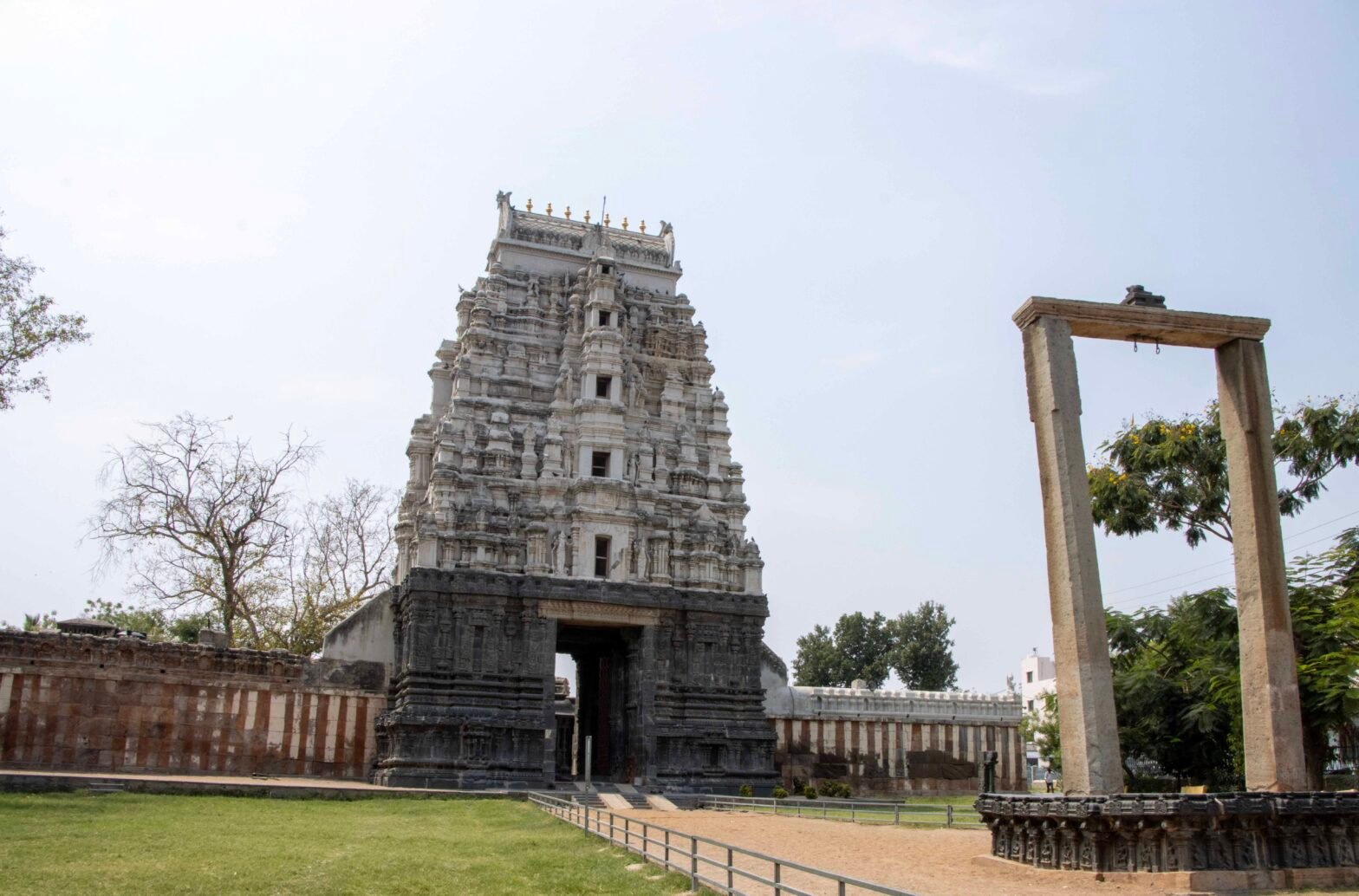
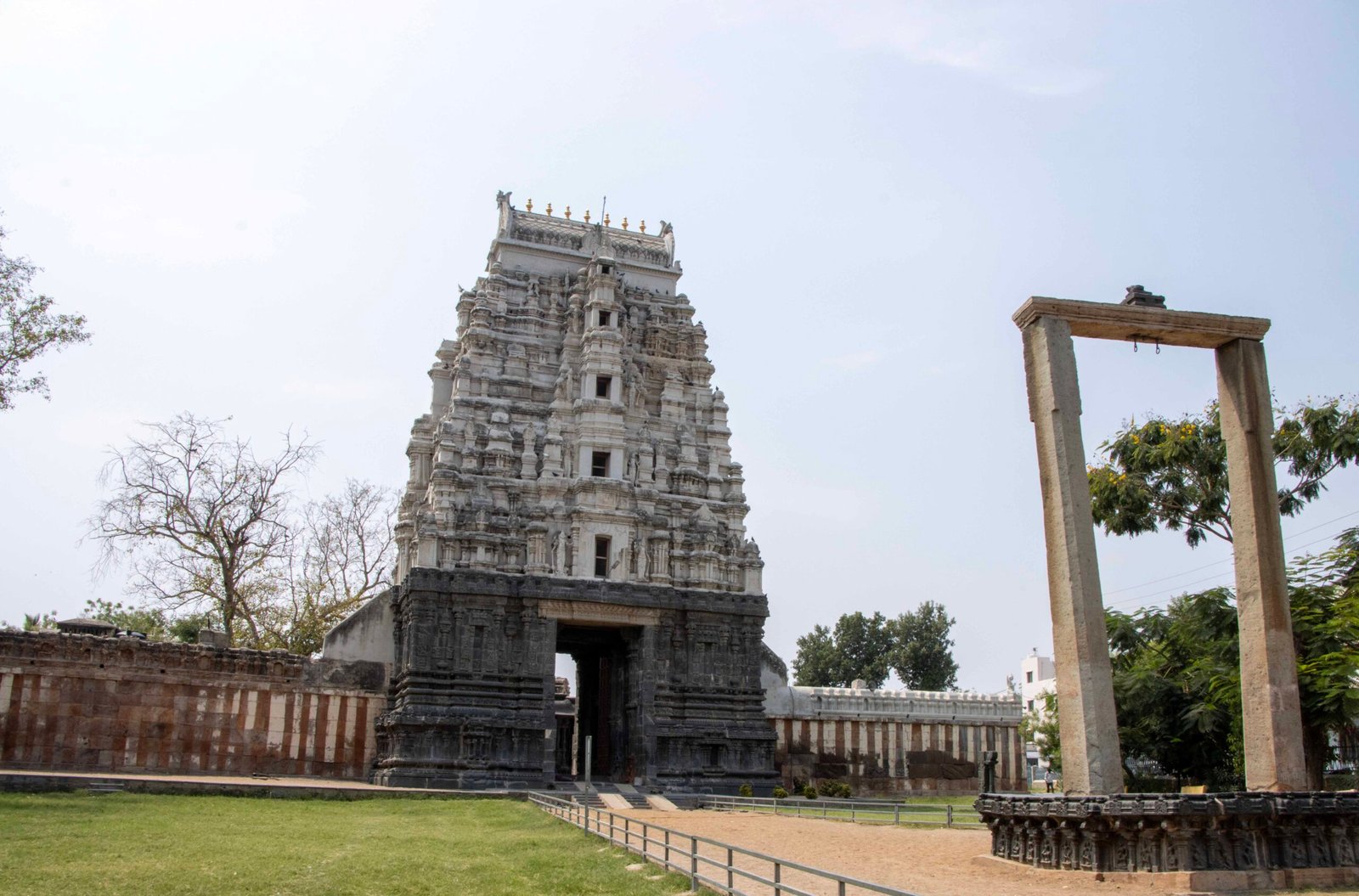
The temple is built in typical Vijayanagara style of architecture and one of the best preserved temple exhibiting the grandeur of that period. The temple is enclosed in a prakara built of huge granite blocks raised to a good height. There are three entrance ways in the Prakara, one in the east surmounted by a Gopura and two others on south and north. Before the east entrance there is structure made of two pillars supporting a beam, which might be used as swing during occasions at those times. In front of this structure there is a tall monolithic pillar erected on a raised square platform. On the inner side of prakara there is a pillared corridor running across wall from south-eastern corner to north gopura.
The main temple is located at the center of the courtyard consisting of a garbhagriha, an antharala, a mukhamandapa, a mahamandapa and chariot shaped structure. The garbhagriha and antharala have closed walls with doorways in the east. The outer walls of these are well decorated with pilasters, projections and miniature shrines. The mukhamandapa is a pillared hall having entrance ways on south, east and north side. The south and north ways are attached with porches opening into courtyards. The east way opens into the Mahamandapa. The central portion of the mukhamandapa formed by four finely carved pillars has the ceiling with two squares one above the other having inverted lotus as central member. The Mahamandapa is a large rectangular pillared hall with two small porches on either corners of front (east) side. The outer row of pillars has mini pillars carved side by side attached to the main pillar which can produce music on tapping.
There is a beautiful chariot shaped structure (similar to that of Hampi chariot) built in between these two porches. This structure has a square chamber surmounted by a pyramidal shaped vimana and is attached with four wheels on sides with two galloping horses in front depicted as dragging the chariot.
There is a shrine dedicated to Lakshmi devi, the consort of lord consisting of a garbhagriha, antharala and a mukhamandapa. The Garbhagriha is surmounted by a Vimana of Nagara order. There is a circular shrine next to the Devi shrine containing only a single chamber surmounted by a single-storied Vimana of Vesara order.
There are subsidiary shrines located in the courtyard on the north side of main shrine found against the east part of north wall. All shrines are facing south and are dedicated to Varaha, Lakshminarayana and Ramanuja.
There is a huge Kalyanamandapa built on an elevated platform in the south-west corner of the courtyard. A room with closed wall is built on the south-east corner.
Art & Sculpture:
The Chintala-Venkataramana temple exhibits the best specimens of Vijayanagara sculptural workmanship. Each and every architectural member of the temple consist of the skillfully carved and ornate elements. The gopuras and Vimanas are well-decorated with stucco figures of various gods and goddess.
The most interesting element of the temple are the narrative carvings done on the outer walls of main shrine in three layers. The carvings depict the scenes from the Ramayana and Bhagavatam which includes episodes such as Sita-Rama marriage, Hanuman reaching Lanka, Hanuman forming his tail as high-seat before Ravana, Lanka war scenes, Sita passing through Agni and so on carved beautifully. There are other carvings such as Narasimha killing Hiranyakasapa, Kaliyamardana i.e. Krishna killing Demon snake king and Krishna stealing butter. One more interesting carving in the temple is the depiction of Mastya avathar i.e. fish incarnation of Vishnu shown as killing Hayagriva, the demon who stole Vedas. It is interesting to note that all the Ramayana panels are labelled in Telugu script.
The pillars of the mandapas in the temple complex are masterpieces for their intensive and art work. The pillars include the figures of females, Yalis, Horse-riders and Elephant heads carved as one unit exhibits the skills of sculptors.
There are faded paintings on the ceiling of the main shrine in Vijayanagara style of art as that of Lepakshi temple.
The most celebrated festivals in the temple are Sriramanavami, Vaikunta-Ekadasi and Mukkoti-Ekadasi. Festivals like Ugadi and Radhasapthami are also celebrated in grand scale. All other holy days as per the Vaishnava agamas are observed in the temple.
6AM-7PM