EXPLORE
Sri Kalahastiswara Temple – Srikalahasti
-
Period : 11th Century,
Deity : Ganesh,
District : Kanipakam, Amareswara, AP
Info:
Srikalahastiswara temple is Vayu (Air/wind) Linga kshetra, one among the
Pancha-bhutha kshetras that are dedicated to Siva. The temple is situated at the
foot of a curved hill on its east on the bank of river Swarnamukhi in Srikalahasti
town in Tirupati district of Andhra Pradesh. The presiding deities are Sri
Kalahastiswara and his consort Gnanaprasunambika. The place derived its name
from the combination of three words viz., Sri, Kala and Hasthi meaning Spider,
Snake and Elephant respectively. The figures of the spider, snake and the
elephant tusks are carved on the Lingam. The temple is also famous for the
Rahu-ketu puja which is performed to get rid of all obstacles caused by celestial
bodies.
Management: Endowments Department of Andhra Pradesh.
The legend has it that a spider, a snake and an Elephant were worshiping the Lingam unknowingly each of them. The snake used to worship by placing a gem upon the Linga, The spider used to worship by spin a web over the Linga and the elephant worship by offering with water from its trunk. One day, the Spider saw gem on the Linga and hid behind it without spinning web. As a result some bilva leaves fell on the Linga. The snake on reaching there, found Bilva leaves and thought that someone had defiled the God. The snake kept a vigil with a view to punish the mischief. The elephant, as usual came with its trunk of water and performed abhishekam with that water. The snake and the spider mistaken the intention of the elephant, thinking that the elephant was spoiling the sanctity and jumped on the elephant to attack. The snake got into the trunk of the elephant which resulted in unbearable pain and breathless state to the elephant. Thus unable to bear the pain the elephant accidentally hit the Linga with great force resulting in crushing to death along with the snake and spider. Lord Siva, in appreciation of their bhakti gave them moksha and self-manifested himself as the combination of those three creatures and hence this placed is named after them as Srikalahasti. The place also include a story of a hunter named Kannapa, who was an ardent devotee of Lord Siva. He used to offer portion of flesh from his hunting to the Linga on daily basis. One day, he noticed that one of the eyes of the Siva lingam was bleeding. Therefore, he plucked his eye and replaced the bleeding eye with this one. After that, he noticed that the other eye of the lingam was also bleeding. He thought that if he would pluck his other eye, he would become blind and would not be able to see where another eye is. So, he placed his foot toe at the spot of the second eye of the lingam and then plucked his second eye to replace it with other eye of linga. Lord Siva was pleased by seeing the pure devotion of Kannappa and appeared before him and restored both his eyes. According to some accounts, Kannappa is considered to be the re-incarnation of Arjuna. Kannappa is also one among the Nayanars, a group of Saivite saints belonging to the 6th/7th centuries CE.
The literature reference to this temple occurs in the work of Nakkeerar, a celebrated Tamil poet of the second century BCE followed by four great Tamil saints viz., Sambandar, Appiar, Manikyavachakar and Sundaramurtei who all sung of the Lord here in their poetry. Adisankara, the great religious reformer also mentioned this place in his famous work Sivanandalahari. The historical inscriptions attest that the temple was built at the foot of Kailasagiri(hill) by the Pallava kings and later by Tondaman Chakravarti of Pandya dynasty. During Chola era, the main temple was expanded and renovated. In 11th century CE, the Great Chola Emperor Kulothunga-I constructed the Galigopura (Entrance Tower) under his personal supervision. Later the Veera Narsimharaya of Vijayanagara empire built the outer prakara with four gopurams and Srikrishnadevaraya , the mighty Vijayanagara Emperor built the 100 pillared mandapa which is attested through a 1516 CE inscription. The coronation of Achuthadevaraya, the successor of Srikrishnadevaraya took place in the temple in the year 1526 CE. The temple complex includes several inscriptions dates to a period between 11th century and 16th century which mostly are donation inscriptions. In 19th century the Nattikottai Chettaiars of Devakottai made some renovations to the temple. In recent times the Krishnaraya tower is rebuilt by the government which was damaged due to crack developed of lighting struck effect.
Architecture:
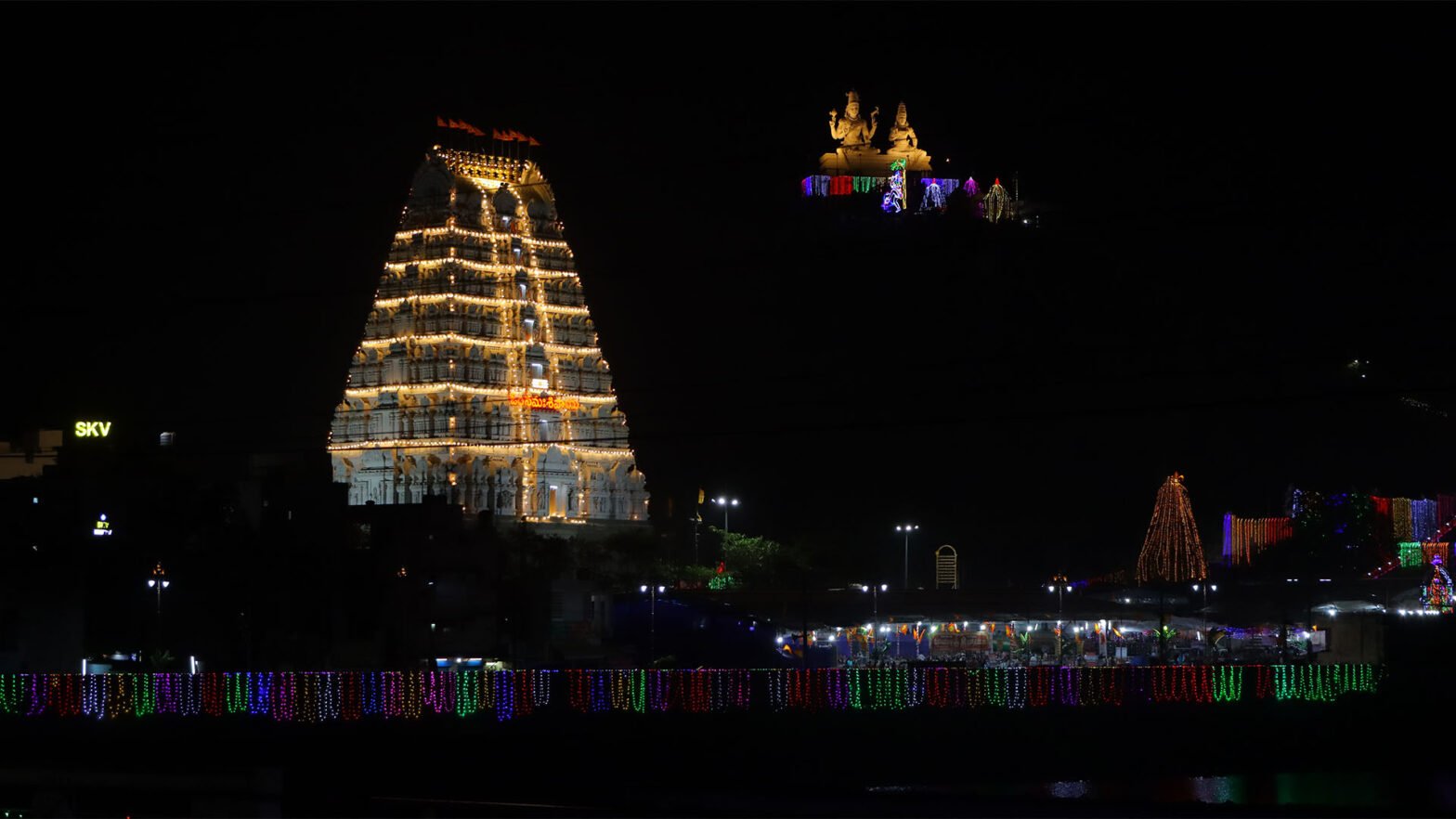
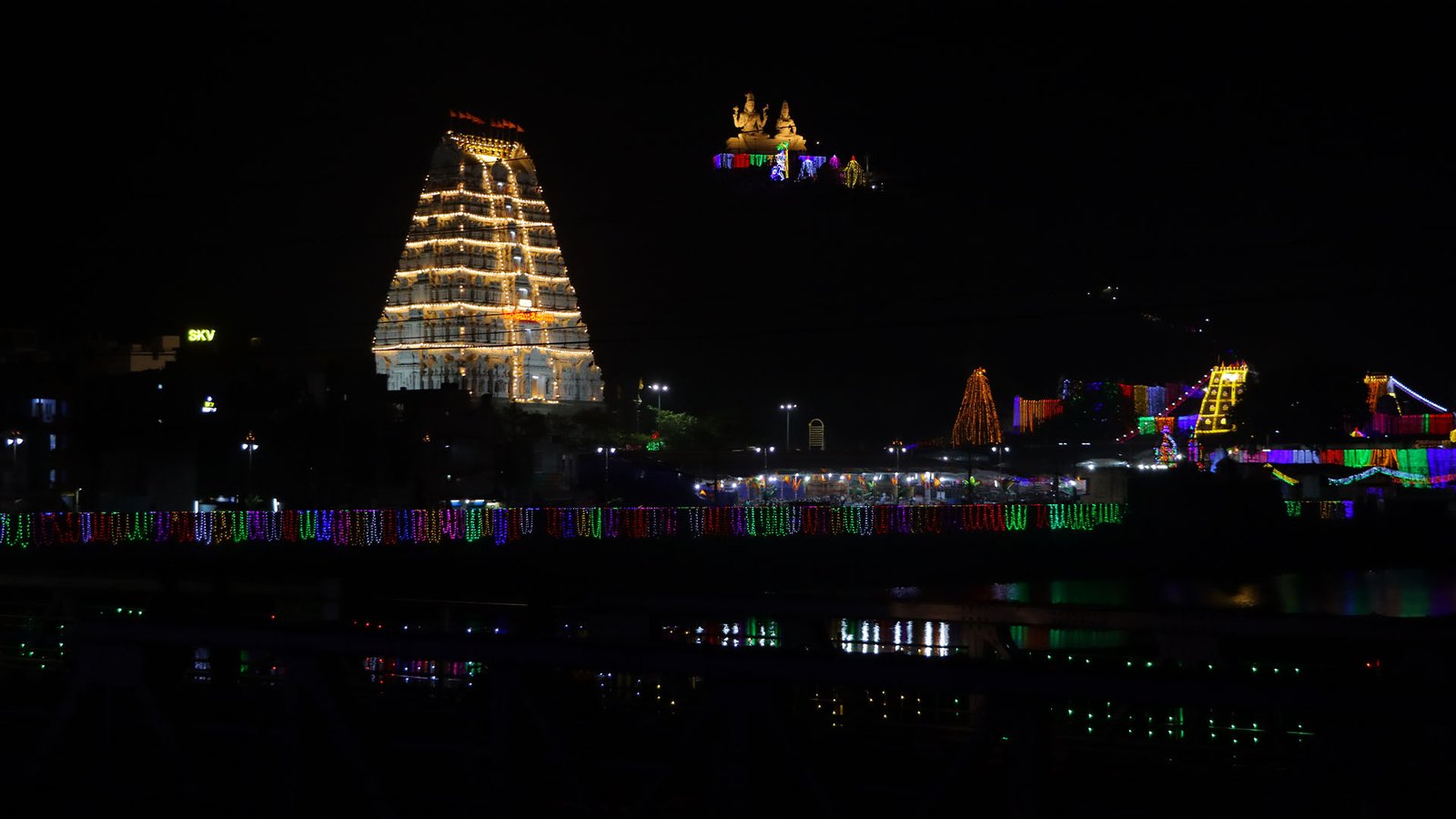
The temple complex consists of several structures that are built during the course of period from the origin of temple from Pallava period and expanded by the successive rulers until Vijayanagara Era. The present temple consists of three prakaras(compound wall) of which the first prakara has the entrance gopura, the second prakara encloses several small shrines, mandapas and the third prakara encloses the main shrine. There is a huge gopura known as Krishnaraya gopura outside of the north wall which leads into the river Swarnamukhi. This gopura has seven storied vimana.
The first prakara has an entrance gopura known as the Bikshala Galigopura built during the period of Narsimharaya and consist of four storied vimana. Inside this prakara there is a temple known as Kasivisveswara temple belonging to the
Chola period consisting of Garbhagriha, antharala and mukhamandapa. The vimana of the temple is of single story. Adjecent to this temple there is a rectangular mandapa and small shrine. The second prakara is accessed through a gopuram known as Balagnanada gopuram with two storied vimana which belongs to the Chola era. The tower is abutted by two shrines dedicated to Ganesha and Kumara and two pillered mandapas. The open enclosure has a number of small shires dedicated to Devi, Linga and other subsidiary gods. There is an underground shrine dedicated to Ganapati known as Patala Ganapati shrine which can be reached a descent of steps, next to it there is an pillared verandah. On the westside of this prakara, there is a huge gopura with two storied vimana and is abutted by various structures on either side. There are shrines dedicated to Ganapati which consists of Garbhagriha, circumambulatory path and two mandapas, Shanmukha shrine consists of garbhagriha, antharala and circumambulatory path. Next to it, there is an elevated hundred pillared mandapa which has eighty-eight pillars arranged in eight rows, each consisting of eleven pillars. On the south side there is a gopura with two stories belonging to Chola period. The third prakara is completely roofed enclosing the main shrine of Kalahastisvara facing the west, the Jnanaprasunamba shrine facing the east, few minor shrines and a huge pillared corridor running on the four sides in the interior. The main shrine belongs to the early Chola period which consists of garbhagriha, antarala, mukhamandapa and circumambulatory path. The Jnanaprasunamba shrine consists of garbhagriha, antarala, mukhamandapa and inner circumambulatory path. The pillered corridor consists of several smaller shrines and platforms which exhibits various Lingas, Nayanars and other subsidiary gods.
Sculpture:
The temple exhibits splendid artistic and sculptural features all over the pillars and walls of the structures. The main attractions of the temple are the rock sculptures carved on gopuras, mandapa pillars and portions of temple walls which include icons of Nataraja,( the dancing Siva), Alinganamurti (Siva along with Parvati), Bhikshatanamurti, Vrishabharudha(Siva riding Bull), Lingodhbhavamurti, Kumara, Ganesha and Durga. There is a particular sculpture depicting the marriage scene of Siva-Parvati in presence of Vishnu and Brahma which is being witnessed by the other gods and goddesses. There are minor icons in the temple complex which includes Dakshinamurti, Bhairava,
Kaliyakrishna, Brahma, Mahishasuramardini, Chandi, Shanmukha, Indra on elephant, Ganas, Salabhanjikas and many other.
The pillars of the mandapas include various sculptures, mainly of Vijayanagara style of decorative features with Vyalas and other carvings on the mighty monolithic pillars. There are panels which exhibits the Sammudramadana scenes in the hundred pillared mandapa. The Gopuras in the temple complex consist of large number of sculptures and decorative features which include the icons of Nrittaganapati, Durga, Siva on Bull and Shanmuka on its main structure and the vimans include the scutto images of various mythological aspects of Siva. The decorative features such as pilasters, niches and capitals of the pillars has rich artistic characters such as Keertimukhas, makharas and other animal features.
The temple is a most celebrated place which attracts huge number of crowd on daily basis as it near to the famous Tirupati temple. The main festivals in the temple are Sivaratri Brahmostavam and Thirukathangai. The Sivaratri Brahmostavam is a 12-day festival celebrated in the temple which include various ritual performances such as Nandiseva, Lingodhbhava puja and other Saiva agama pujas. The Annual Kalyanostavam is performed and the deities are taken for possession in Temple cart into the streets of town on the day of Radhostavam and on a boat in the temple tank on day of Theppostavam. Rahu-Khetu puja which is performed on daily basis is one of the famous ritual in the temple that attracts crowds from all over the country. It is performed to get rid of the Doshas caused by the influence of celestial bodies. The temple includes the daily rituals which include abishekams, pujas and sevas as per the agama texts. Along with this all festivals related to the Saivism are celebrated in a grand scale.
6AM-9PM