EXPLORE
Sri Bhimeswara temple
-
Period : 9th Century,
Deity : Shiva
District : Draksharamam, Ambedkar- Konaseema district, Andhra Pradesh.
Info:
Sri Bhimeswara temple at Draksharamam is one among the Pancharamas, five sacred places of Siva located in the state of Andhra Pradesh. The temple is located in Draksharamam town in BR Ambedkar- Konaseema district of Andhra Pradesh
Management: Archaeological Survey of India (ASI)
Legend has it that according to the well-known story of Sivapurana, Daksha Prajapati had given his daughter Dakshayani in marriage to Lord Siva. On one occasion, Daksha built a big Yagasala on the bank of one of the sacred branches of the Godavari, near its confluence with the sea and performed a sacrifice. He invited all his daughters along with their husbands except Dakshayani and Siva, on the occasion. Dakshayani, though uninvited, still on account of filial love, attended the yajna but found that she was not received and respected properly. Dakshayani took this insult seriously and jumped into the sacrificial fire. When Siva heard of this, he began to sweat in fury and out of that sweat was born Virabhadra, who killed Daksha and thus avenged the insult to Lord Siva. Siva rushed to the sacrificial fire, rescued Sati and received her into the left half of his body. In memory of it, even today, the orthodox Brahmins do not perform any yajna or such ceremonies within Draksharama.
Later Dakshayani was born to Himavantha, known as Uma, married Siva and both of them came to reside here and thus this place is named after Dakshayani as Daksharama, later called as Draksharama.
The temple is believed was built by Chalukya Bhima I, the Eastern Chalukyan King who ruled from 897-922 CE. The temple is mentioned as the greatest and important in multiple inscriptions engraved on the temple walls. (The epigraphy sources state that Kuppanarya, an officer of Amma II (Eastern Chalukyan ruler, 945-970 CE) built a temple to Siva at Draskharama. As there is no other ancient temple found in the town, some scholars opine that it is same as the Bhimeswara temple.)
There are many inscriptions engraved on the temple walls, out of which the earliest belongs to 1081 CE. This attest the existence of the temple by that time. The temple received expansions and renovations in subsequent periods. The Reddis of Kondaveedu and Rajahmundry added many structures to the temple and several endowments and gifts were made for its maintenance.
Architecture:
The architecture of the Bhimeswara temple is very interesting as that of remaining Pancharama temples consisting of a double storied central shrine. Major construction of the temple is done during the period of Chalukya Bhima I, the mighty Eastern Chalukyan ruler. The temple underwent expansion under the rule of Reddi’s of Kondaveedu.
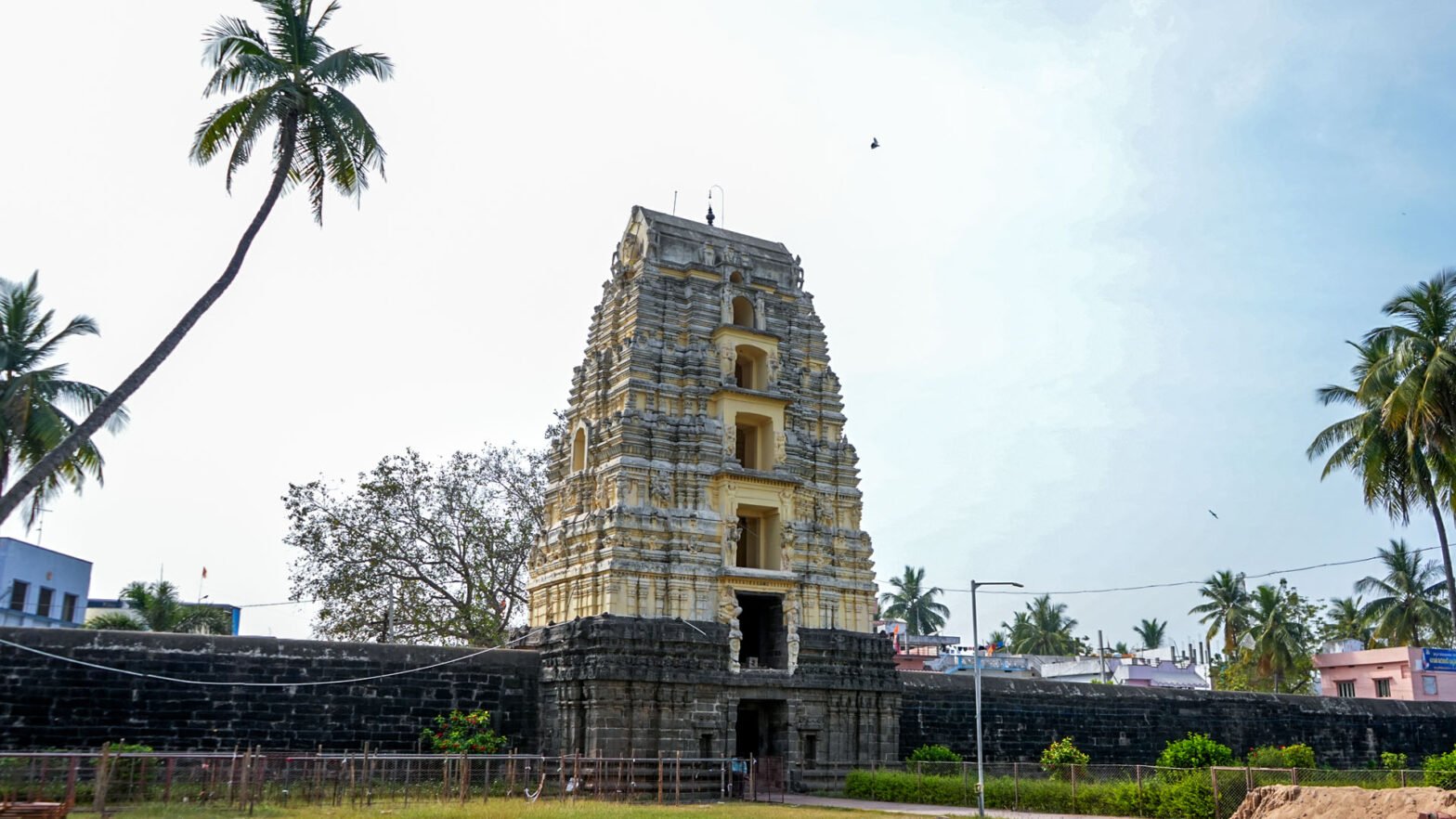
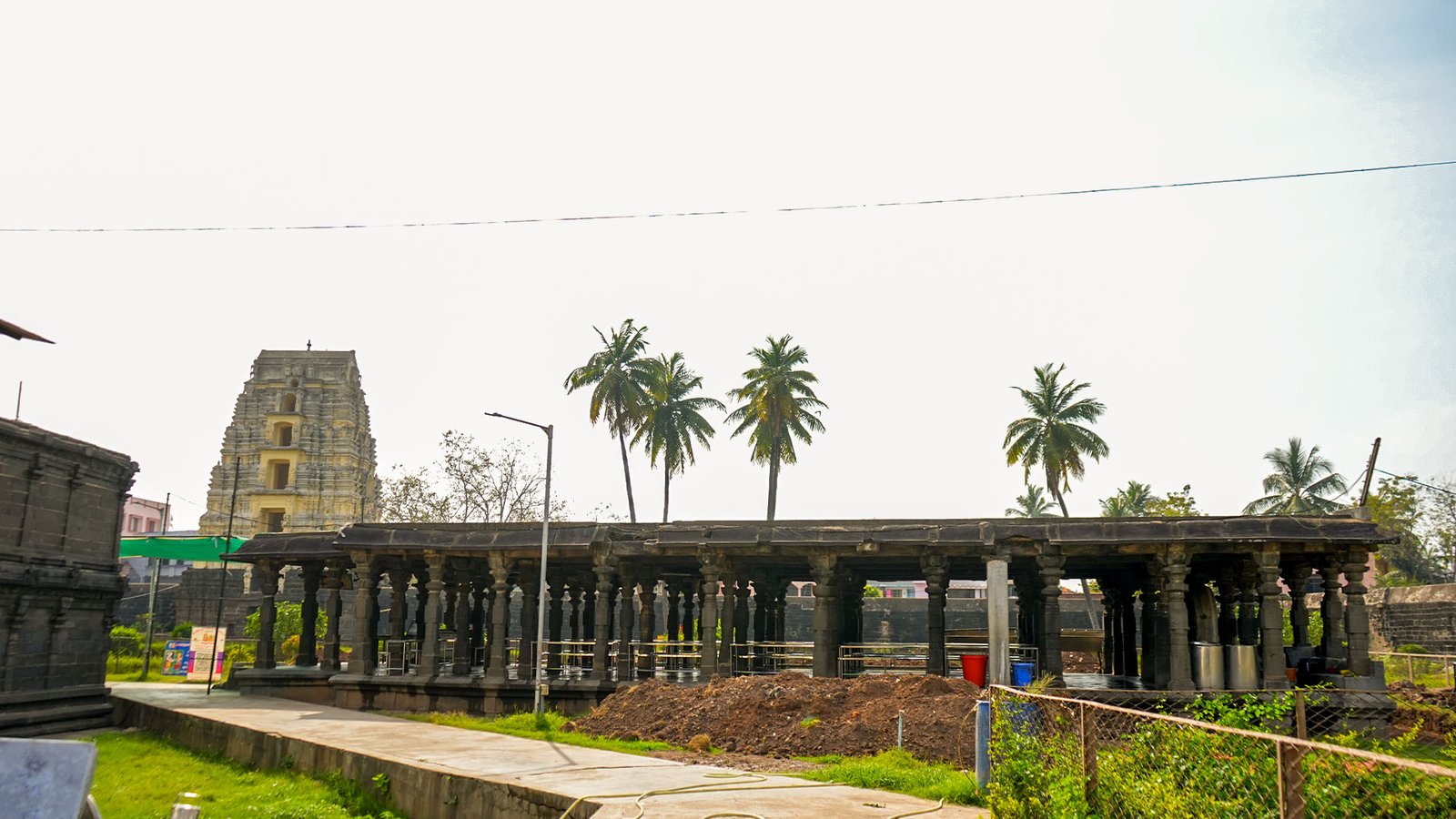
The temple is enclosed by two prakaras (compound walls) separated by spacious courtyard in which minor shrine and mandapas are seen. The outer prakara is built of huge granite blocks raised to a great height as that of fort walls. There are four entrances on four directions surmounted by a Gopura (temple tower). The west Gopura is larger than the remaining and has a mandapa infront of it. The tower consists of well-defined decorative architectural members. The outer enclosure consists of a Shrine dedicated to Kalabhairava in the north-eastern corner consists of a garbhagriha and antharala.
The inner prakara is also built with huge blocks of stone raised to a height of twenty feet with entances on south and east sides. The south entrance is now being used as the main entance. The inner portion of the prakara is attached with a two storied cloister (covered pillared corridor). There are few shrines in the cloister housing various gods.
The main shrine is located at the center of the inner enclosure consisting of a double storied structure. The plan on ground is rectangular with ground floor consisting of a mandapa and hall enclosing the sanctum. The first floor is reached through a flight of steps from either side of mandapa of ground floor. The first floor consists of a garbhagriha, an antharala, a mukhamandapa and a mahamandapa. The garbhagriha has four doorways in four directions as that of Sarvathobadra model. The temple belongs to sandhara type, in which the circumambulatory path is within the enclosed wall around the garbhagriha. (Now the path is closed). The Vimana on top is of Dvitala (two-storied) and belongs to Nagara order.
There are subsidiary shrines and mandapas built around the main shrine in the inner enclosure.
Art & Architecture:
The temple consists of several sculptures carved on the pillars, lintels and temple towers. There are icons of various forms of Siva such as Sarabhesamurti, Virabhadra, Nataraja, Lingodhbhavamurti, Vatuka Bhairava and other forms carved on the temple architectural members. In addition to these there are images of Ganesha, Durga, Kartikeya, Mahishasuramardhini, Narayana, Surya and other Devas carved on the pillars of the temple.
There are panels of Siva mythological stories such as Kiratarjuna and Mrigavadha carved beautifully on the pillars of the Mandapa in the main shrine. There are images of Anavemareddy and Kumaragirireddy carved on the east entrance mandapa pillars.
The nandi in the main shrine is carved out of a monolithic stone and fashioned with various ornate elements on its body.
The most celebrated festival in the temple is the day of Sivaratri, on which the temple draws huge crowd throughout the day. Few rituals and special pujas are performed on that day. All other holy days as per the Saiva agamas are performed in the temple.
6AM to 8PM