EXPLORE
Sri Veereswara Temple – Pattiseema
-
Period : 12th Century,
Deity : Siva
District : Pattiseema, West Godavari, Andhra Pradesh
Info:
Sri Veereswara Temple is one of Pancha-Kasi kshetras, other 4 are Srisailam, Kashi, Kedarnath and Srikalahasti. It is located on a small hillock named Devakutam Island in the Godavari River in Pattiseema village in Polavaram mandal of East Godavari district. The temple can be reached only through a boat ride in the waters of Godavari.
The presiding deity of the temple is Lord Veerabhadra in the form of Linga and perhaps the only temple in India where Veerabhadra is seen in Linga form instead of iconic form.
Management:
Endowments Department of Andhra Pradesh.
Legend has it that, Daksha did not invite Lord Siva and Sati to the Yagna conducted by him. Knowing about this, Sati went to the yagna uninvited even when Lord Siva asked her not to go to the yagna. Sati reached the yagna spot and asked her father Daksha the reason for not inviting Lord Siva while Daksha invited all other Gods. Daksha insulted Lord Siva and Sati was angry and felt sad for not obeying Lord Siva. Sati immolated herself by jumping into fire pit of Yagna. Angered upon hearing about the death of Sati, Lord Siva plucked a lock of hair from his head and smashed it on the ground, breaking it into two with his leg. From it emerged, Lord Veerabhadra and Bhadrakali. Lord Siva ordered Veerabhadra to destroy the yagna and kill Daksha. Veerabhadra cut the head of Daksha with Pattisa, a weapon and killed him. Even after killing Daksha, the rage of Veerabhadra did not subside. Agastya muni embraced Lord Veerabhadra with his hands to calm him down. Agastya muni requested Lord Veerabhadra to settle down on the hillock and Lord Veerabhadra agreed & manifested there in the form of Sivalinga. Agastya muni also collected the unbraided long hair and tied it into a knot on the forehead of Lord Veerabhadra now in the form of a Linga. Veerabhadra swamy cleaned his pattisam in this river Godavari & hence this places is called as Pattisam or Pattisachala kshetram.
The temple was built duruing the rule of Reddis of Kondaveedu in the 14th century and received gifts and land endowments. For most of the time the temple is patronized by the local chiefs attested by the few epigraphy and literary sources. The temple is renovated by the Kocherla Kota Zamindars of Polavaram area during the British period. They built subsidiary shrines around the temple by installing the loose sculptures found in the temple compound.
Architecture:
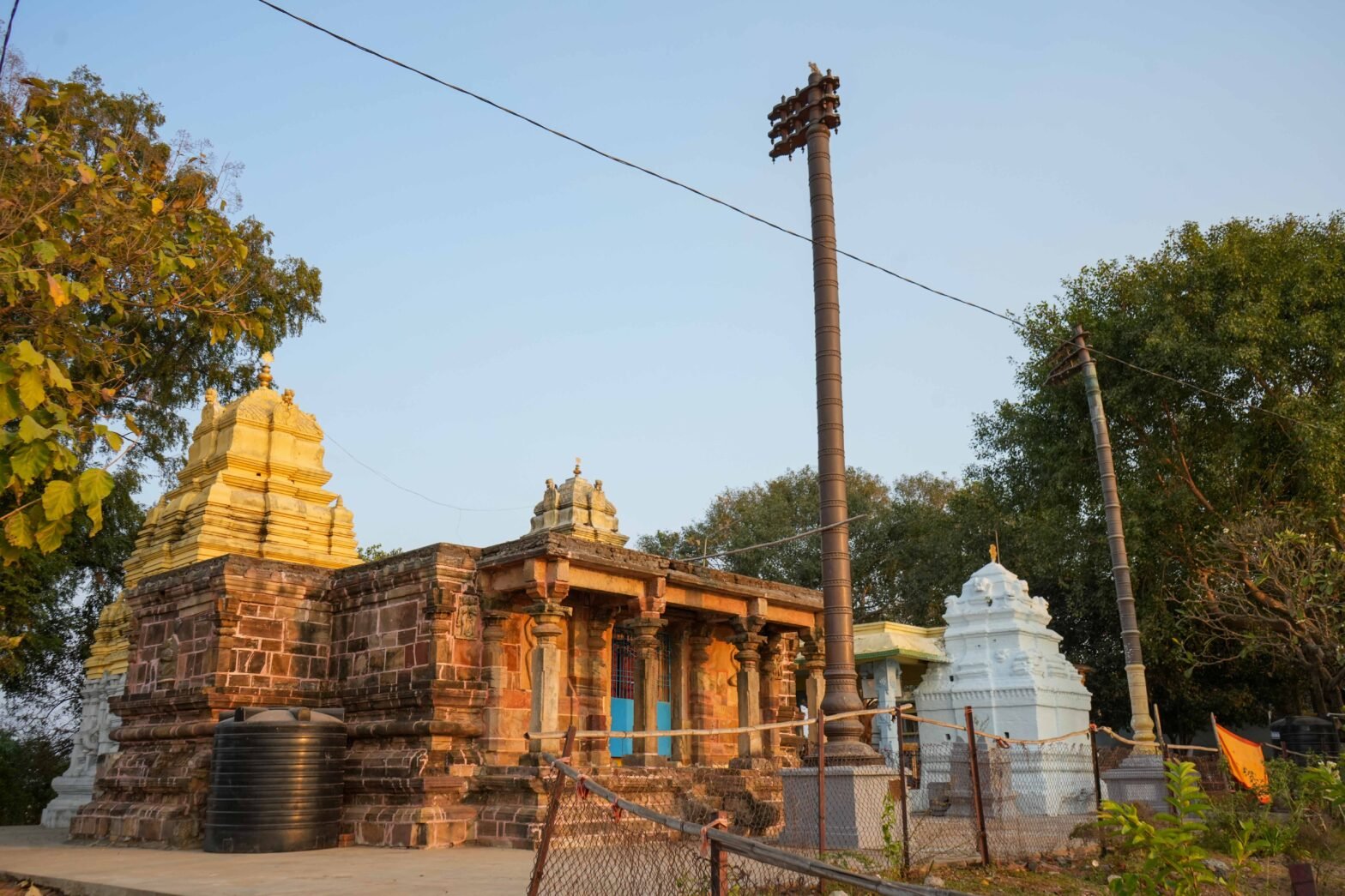
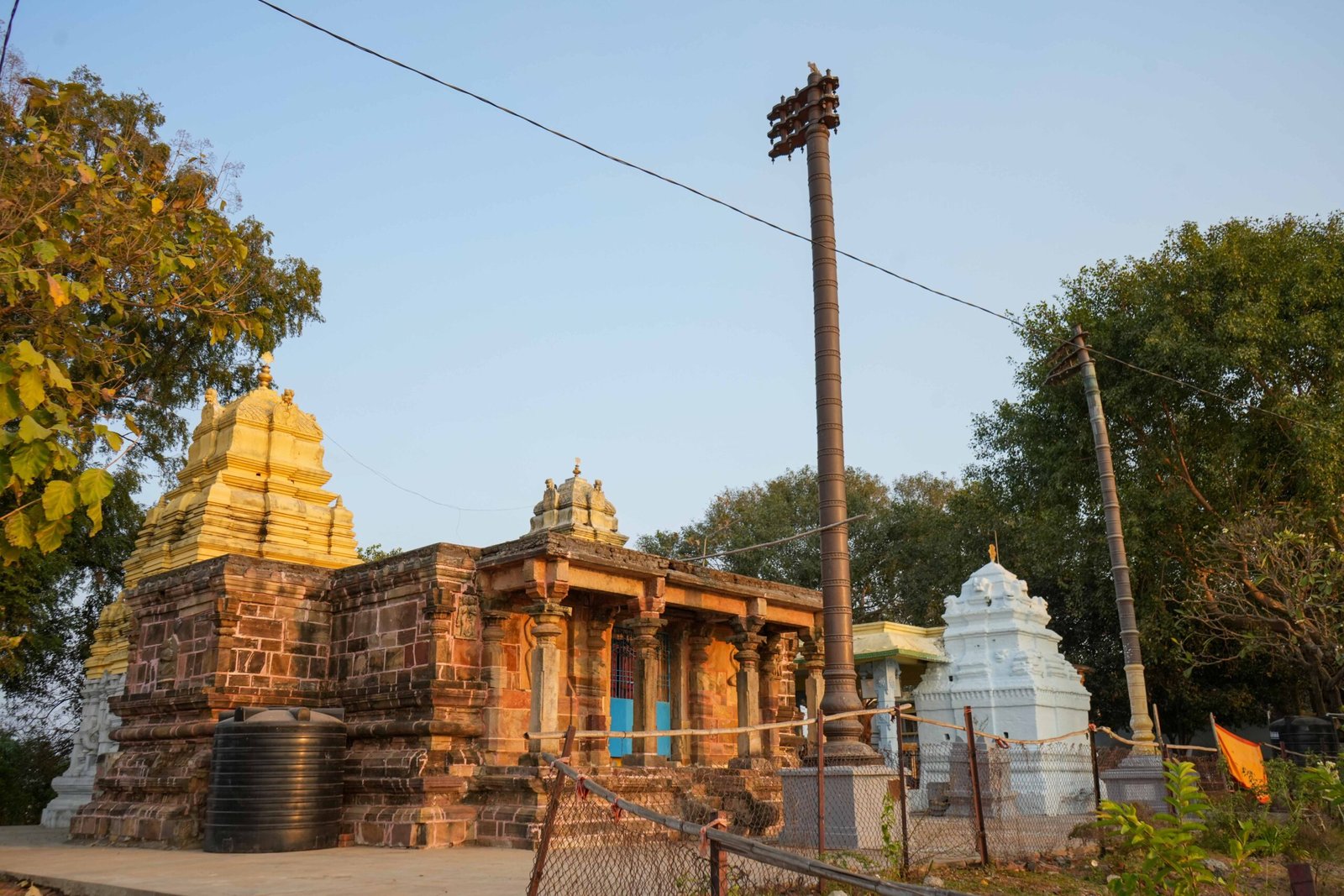
The temple is located on the top of island reached through a flight of steps from the bank of River. The temple complex consisting of many subsidiary shrines is enclosed by a compound wall on all sides.
The Main shrine is located at the centre is completely built in stone. The shrine consist of a Garbhagriha, an arthamandapa and a mukhamandapa, all constructed on an elevated plinth. The garbhagriha is a square chamber with covered roof supported by pillars and space between pillars is closed by stone wall. The doorway in east opens into another small square chamber connected to Mukhamandapa through another doorway. The Mukhamandapa is a closed hall with central portion supported by four pillars. There is a small porch having four pillars on front portion built attached to shrine. There are flight of steps attached to reach the porch, which are now half-submerged into ground. The Vimana built on the roof of the shrine is a five-storied pyramidal structure belonging to the Dravidian order.
There are few subsidiary shrines around the temple built in the recent times. Out of them the notable temples are Veerabhadra shrine, Ganesha shrine, Durga-Mahishasura Shrine and Sri Bhavanarayana temple. There are other temples dedicated to Rama, Surya, Saraswati, Alwar and Anistri-Punistri, the local village deities.
Art & Sculpture:
The sculpture in the temple complex are found in the form of icons of deities and few carvings are found on the outer wall of the main shrine. The carvings on the wall include Mithuna pair, a woman holding a baby is depicted sitting on man lying under her and on either side of the Mukhamandapa entrance there are carving of a Saints depicted standing on single leg with the other leg bent and supported while the hands are stretched upwards forming Namaskara mukdra.
The most interesting icon in the complex are Ganesha and Veerabhadra. The Ganesh icon is depicted with ten arms holding different weapons and his consort Siddi is seen seated on his lap. The Veerabhadra icon is actually the Nataraja form of Siva, seen in dancing pose with multiple arms holding weapons. There are other icons such as Surya, Kartikeya and Mahishasuramardhini.
The most celebrated festival in the temple is Sivaratri. Few special rituals are performed on that day. All other festivals as per the Saiva agamas are performed in the temple in additionals to the common festivals like Ugadi, Sriramanavami and Navaratri.
6AM- 10AM, 3.30PM-7PM